Trends in the real estate market in the thrid quarter of 2025
No. 27 - September 2025
Quarterly highlights: January - September 2025
The new G-Trends is now available, Gloval’s quarterly report that gathers the keys regarding the macro environment, the analysis of real estate segments and delves into certain current issues in the sector. This edition also has a new, more visual and attractive design.
Here is an introduction to some of the topics that we will be covering in this new real estate trends report for the third quarter of 2025:
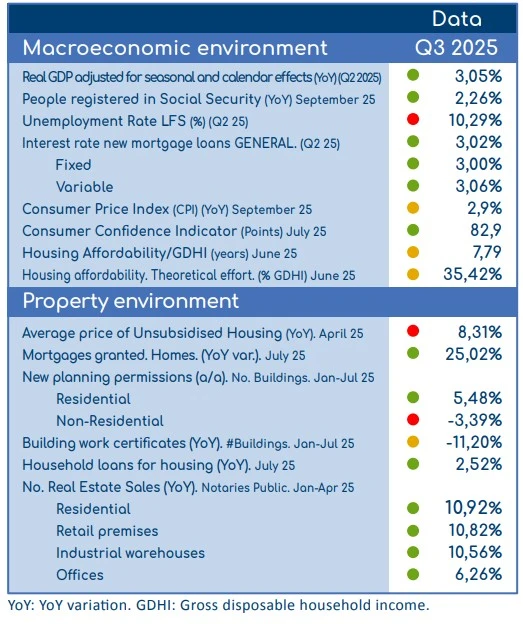
Balanced Scorecard - Q3 2025
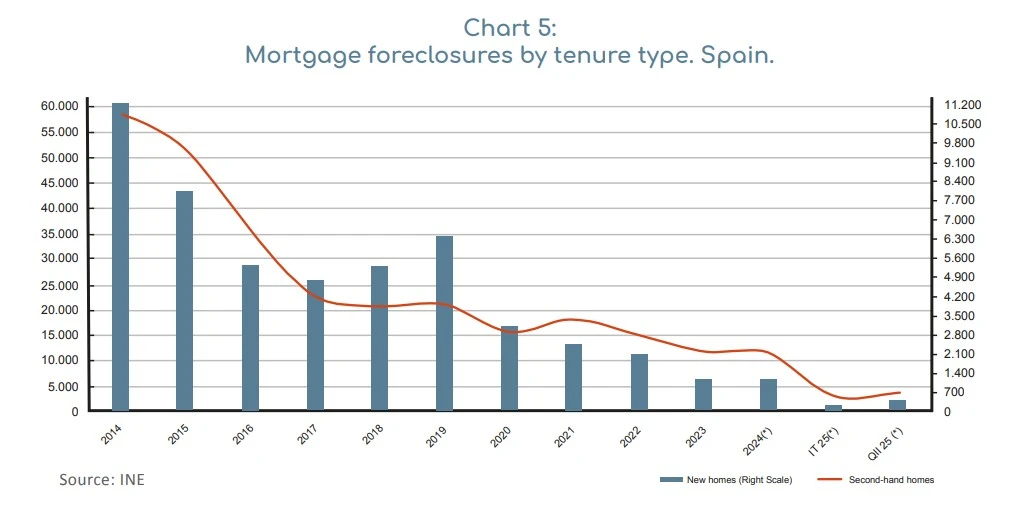
Trends in mortgage foreclosures in recent years. (2014–2025 (iit))
The trend in mortgage foreclosures on primary residences owned by individuals has fluctuated somewhat in recent years, but the overall trend has been downward, with a reduction in the number of foreclosures on both new and second-hand homes. It is a lengthy legal process lasting more than three years, which skews the statistics provided by the INE (Spanish National Institute of Statistics) and registrars, as figures are not shown in real time.
The granting of new mortgage loans on commercial properties
The evolution of data relating to the granting of credit for commercial real estate (CRE) mortgages is closely linked to the country’s macroeconomic context, especially monetary policy guidelines and their relationship with inflation trends. In Europe, the major economies are not at their best in the cycle and, in an attempt to revive them, apart from factors external to the EU, the European Central Bank has moved to reduce interest rates to levels close to the 2% inflation target. However, there are countries such as Spain, with good growth figures but uncontrollable inflation data, where these low rates may affect supply.

The new ECO/805/2003 order: progress, benefits and challenges for valuation
Almost two months after the entry into force of the amendments to Order ECO/805/2003 on rules for the valuation of real estate and certain rights for specific financial purposes, it is logical to ask what the real situation is regarding the effectiveness of these amendments, given the benefits they were intended to bring and the challenges they entailed.
Among the benefits incorporated into the regulation are aspects such as greater transparency in valuations and greater technical rigour, as well as alignment with European and international standards, which are simultaneously posing major challenges for the valuation sector in areas such as the adaptation of internal processes, the adaptation of teams in continuous training with regard to new developments, and agility in reducing the transition time to these new requirements as much as possible.
You may also see our previous Real estate trends and our latest GIX Reports, where we analyse the main real-estate economic indicators in Spain.

 Download several reports
You can download all our reports at the following link:
Let’s have a chat
Let us know what you need and we’ll contact you as soon as possible.
They trust us